

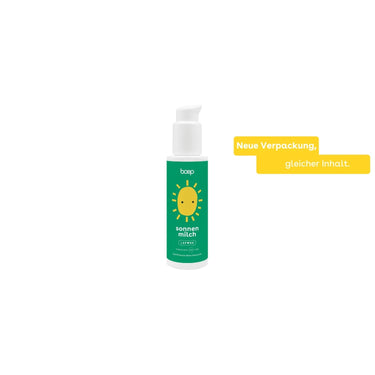


Mineral Sun Milk SPF 50
Pickup available at das boep GmbH
Usually ready in 2-4 days
- high sun protection factor with SPF 50
- light, vegan formula with tocopherol (vitamin E) and moisturizing glycerin
- immediately and effectively protects against UVA and UVB radiation with a purely mineral zinc oxide filter
- skin compatibility dermatologically tested, rated "very good" and certified by Dermatest (you can find details about our certificates here)
- suitable for the sensitive skin of babies and pregnant women
- compliant with the Hawaii Reef Act*
- not highly water-resistant (you can find more information here)
boep Mineral Sun Milk SPF 50




FAQ
Frequently asked questions about our sunscreens
What does “mineral filter” mean?
There are two types of UV filters used in sunscreens: organic filters, colloquially called "chemical" filters, and inorganic filters, better known as "mineral" or "physical" filters. [1] Sunscreens with chemical UV filters penetrate the skin, absorb the sun's rays and convert them into heat energy. Mineral filters, on the other hand, sit on the skin and reflect the sun's rays, thus forming a physical barrier and preventing the UV rays from penetrating the skin cells. [2]
Some chemical filters are suspected of having a hormonal effect, as this effect has been partially demonstrated in cell and animal experiments. According to current knowledge, the Federal Institute for Risk Assessment has so far classified only one chemical sun protection factor as harmful to health; however, a "re-evaluation of approved UV filters at European level should be sought". [3] [4]
Our certified natural cosmetic sunscreen protects your skin and that of your children with a purely mineral zinc oxide filter. Zinc oxide has proven to be a safe ingredient for baby and child care products and is also environmentally friendly on beach holidays. Did you know that some chemical filters are already banned in Hawaii and Palau because they pollute the seas and bleach corals? [5] [6]
[1] Serpone N. et al. Inorganic and organic UV filters: Their role and efficacy in sunscreens and suncare products . Inorganic Chemistry Acta, 2007, 360, 794–802
[2] Meinhard, E. Service: Sunscreens tested . For ARD | DasErste.de, 2018. Online at: https://www.daserste.de/information/politik-weltgeschehen/morgenmagazin/service/service-Sonnenschutzmittel-Test-100.html (28.05.2018)
[3] Throl, C., Thomas, K. Sunscreen tested: Which sun protection we recommend for the skin . In: ÖKO-TEST June 2018, 2018. Extract online at: https://www.oekotest.de/kosmetik-wellness/Sonnencreme-im-Test-Welchen-Sonnenschutz-wir-fuer-die-Haut-empfehlen_111085_1.html (24.05.2018)
[4] Federal Institute for Risk Assessment (BfR), Information, tips and recommendations on sunscreen products, 2005. Online at: https://www.bfr.bund.de/cm/343/informationen_tipps_und_empfehlungen_zu_sonnenschutzmitteln.pdf (22.08.2005)
[5] n-tv, Hawaii bans UV filters: Sunscreens harm marine animals , 2018. Online at: https://www.n-tv.de/wissen/Sonnencremes-schaden-Meerestieren-article20497528.html (26.06.2018)
[6] n-tv, Holiday paradise protects corals: Palau bans most sunscreens , 2018. Online at: https://www.n-tv.de/wissen/Sonnencremes-schaden-Meerestieren-article20497528.html (02.11.2018)
What is the difference between the sun cream family and the sensitive sun creams?
The Sensitiv sunscreen (SPF30 and SPF50) and the sunscreen family (SPF30) only differ in scent.
Our sunscreen family in the yellow tube smells very delicate and fresh like our boep scent.
Our Sensitive sun cream in the white tube has no fragrance and therefore protects highly sensitive baby skin and skin prone to sun allergies in a particularly gentle way.
What is the difference between sun milk and med sun milk?
First, let's look at the similarities: Both sunscreens have a light consistency and offer you extra high sun protection with SPF 50
against UV rays.
The main differences lie in the scent and the formulation. Our SPF 50 sun milk has a very delicate and fresh scent, our boep scent. If your skin is prone to neurodermatitis or sun allergies due to certain ingredients, we recommend our med sun milk. It is free of
fragrances and also impresses with its hypoallergenic formulation. Ultimately, the choice between the two products depends on your skin type and your individual needs.
How does our Mineral Sun Cream Sensitive SPF 50 differ from our Med Sun Balm SPF 50?
First, let's look at the similarities: Both creams are excellent for facial use and offer extra high sun protection with SPF 50.
The main difference between the two products lies in their consistency and cream base: The sun cream is water-based, while the sun balm is formulated on an oil base. This makes the balm noticeably richer and provides additional protection against cold in winter. Since it is water-free, it also does not require preservatives and is therefore particularly well-tolerated by very dry or sensitive skin, such as
that with neurodermatitis. Especially in spring, when the skin suffers from dryness, the sun balm is the right choice for use on the
face.
Ultimately, the choice between the two products depends on your skin type and your individual needs.
What's the difference between our Mineral Sunscreen Sensitive SPF 50 and our Mineral Sun Milk SPF 50?
The sunscreen Sensitiv SPF50 and the sunscreen milk SPF 50 differ in both scent and consistency. Our mineral
sunscreen milk has a very delicate and fresh scent of our boep fragrance, while the mineral sunscreen Sensitiv SPF 50 is fragrance-free. The sunscreen is particularly suitable for use on babies, children, and the face, while the sunscreen milk is significantly thinner and therefore easier to apply. Ultimately, the choice between the two products depends on your skin type and your individual needs.
What is the difference between our Sunscreen Sensitive SPF 50 and our Med Sun Milk SPF 50?
First, let's look at the similarities: Both sun products are fragrance-free and are therefore excellent for use on very sensitive skin. In addition, with SPF 50, they offer you extra high sun protection against UV rays.
The Sun Cream Sensitive SPF50 and the med Sun Milk SPF 50 differ mainly in consistency: the sun milk is significantly
thinner and therefore easier to apply to the whole body.
If your skin tends to atopic dermatitis or sun allergies due to certain ingredients, we recommend our med Sun Milk. It is free of
fragrances and also impresses with its hypoallergenic formulation. Ultimately, the choice between the two products depends on your skin type and your individual needs.
What does “compliant with the Hawaii Reef Law” mean?
All boep sun care products do not contain the chemical UV filters oxybenzone, octinoxate and octocrylene and are therefore compliant with the Hawaiian Reef Law.
The Hawaii Reef Law first came into effect in 2018 and prohibits the use of sunscreens with the above-mentioned UV filters in Hawaii due to their coral-damaging properties.
Excerpt from the law: "Oxybenzone and octinoxate cause mortality indeveloping coral; increase coral bleaching that indicates extreme stress, even at temperatures below 87.8 degrees Fahrenheit; and cause genetic damage to coral and other marine organisms. These chemicals have also been shown to degrade corals ' resiliency and ability to adjust to climate change factors and inhibit recruitment of new corals." (Page 1)
Do the sunscreens contain chemical filters?
No. Our sunscreens do not contain chemical UV filters and are compliant with the Hawaii Reef Law* . The Hawaii Reef Law prohibits the use of sunscreens that use oxybenzone, octinoxate or octocrylene as UV filters because they can harm corals.
We deliberately chose a purely mineral zinc oxide filter. The mineral UV filter does not interact with the skin, but sits on the skin like a mirror and reflects the sun's rays. In addition, all boep sun creams are certified according to the strict COSMOS NATURAL guidelines for controlled natural cosmetics. COSMOS NATURAL does not allow the chemical UV filters mentioned above.
Do your sunscreens contain nanoparticles?
Our sunscreens use zinc oxide, a naturally occurring, inorganic substance, as a UV filter. For use in cosmetics, zinc oxide is reduced in size so that it can be processed as a powder. The question often arises about the size of the comminuted particles - especially whether the particles are nanoparticles (size between 1-100n m). According to the requirements of the European Commission, nanoparticles must be marked in the list of ingredients if they are nanomaterial, i.e. more than 50% of the particles are nano-sized. According to these specifications, the filter we use is not nanomaterial, but individual particles can still be nano-sized.
The question of whether nanoparticles are good or bad for the skin is not just about size, but above all about the question of whether they are “biopersistent”, i.e. can remain in the skin. And that is not the case with our sunscreen, which only contains zinc oxide particles. In recent years there has been a lot of different information about nanoparticles, but not all of it has been scientifically validated and has unfairly caused uncertainty among customers. Please take a look at this general article here .
DO YOUR SUNSCREENS CONTAIN THE CONTROVERSIAL PLASTICIZERS EVERYONE IS TALKING ABOUT?
Since our sunscreens are certified natural cosmetics, you will not find the controversial plastic softeners, so-called phthalates, in our ingredients.
DO YOUR SUNSCREENS CREATE SO-CALLED "FREE RADICALS"? IS THE ZINC OXIDE IN YOUR SUNSCREENS COATED?
The topic of "free radicals" is complex and it is fundamentally important to understand that the formation of "free radicals" is a normal process in the body. For example, they are formed during normal metabolic processes, when smoking or through air pollution or during inflammatory reactions. They can also be formed by UV radiation. However, humans have protective mechanisms for this and usually cope well with it. In addition, there are substances called antioxidants that are either formed by the body or contained in creams/food that bind these free radicals and thus render them harmless. As long as the balance of these substances is established, you do not need to worry too much about this topic. Take a look at this article by Anni , where everything is explained in detail and examples of foods that have a high antioxidant value are also given.
Our creams always contain antioxidants , which are either contained in the vegetable oils or, as in the case of vitamin E, added as tocopherol. The dispersion in neutral oil in the sun cream ensures that the zinc oxide is optimally dissolved. Here, too, we naturally pay attention to the use of antioxidants. We have passed on the question about the coating to our supplier again, but consider it unlikely that the formation of free radicals, which can be caused by UV light and which, as mentioned, is a physiological process, can be prevented by a coating. We will be happy to keep you updated on our findings. And of course it is important to prevent the formation of free radicals in the skin as best as possible by applying sun protection!
ARE YOUR SUNSCREENS WATERPROOF?
Fundamentally, no sunscreen is 100% waterproof, even if advertised as such. For context: sun products receive the "waterproof" claim if at least 50% of the sun protection factor remains after 40 minutes of swimming during testing. However, it's good to know that UV protection follows a logarithmic curve, meaning that the protection at SPF 5 is very low, then increases massively between SPF 10 and SPF 20, and reaches almost 90% from about SPF 25 upwards. Further protection, such as SPF 50 for example, only adds a few more percentage points; the curve flattens out and never reaches 100%. This is a bit mathematical, but it means: with a sunscreen with SPF 50, a good amount can wash off and the protection is still there, as long as it doesn't fall below SPF 10. Our tip, therefore: apply a really generous amount in the morning before you go into the water, and then reapply immediately after swimming. This way, with a sufficient amount, you should have adequate protection in the water. Reapplication should also always be done after heavy sweating.

the boep Sun Guide
Find the right product from our sun care range
Not sure which sunscreen or after-sun lotion suits your needs and your skin?
Our guide will help you find the right product with just a few questions! 🥰

mineral sun protection
Good for you – and the environment!
Our sunscreens comply with the Hawaiian Reef Law, which means they do not contain coral-bleaching chemical UV filters such as oxybenzone, octinoxate and octocrylene. They provide immediate protection after application and therefore have no hormonal effect. Over 99% of the total product is of natural origin.

For young and old
Whether baby or child, pregnant or breastfeeding, normal or sensitive skin - our sun protection has something for everyone! The sun creams protect with a purely mineral zinc oxide filter and are very easy to spread. While the sun cream family impresses with a light summer scent, our sensitive variants do not contain perfume and are also proven to be effective for problem skin.