


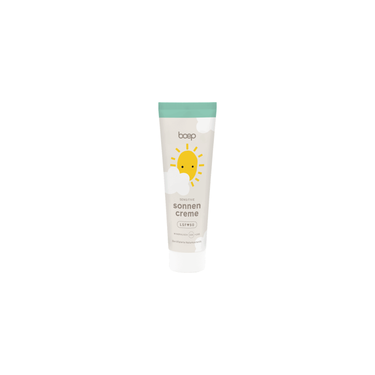


Mineral Sunscreen Sensitive SPF 50
Pickup available at das boep GmbH
Usually ready in 2-4 days
*Without the UV filters: oxybenzone, octocrylene and octinoxate
Gesetzliche Gewährleistungsrechte

boep Mineral Sunscreen Sensitive SPF 50




FAQ
Frequently Asked Questions About Our Sunscreens
What does "mineral filter" mean?
There are two types of UV filters used in sunscreens: organic filters, also colloquially known as "chemical" filters, and inorganic filters, which are better known as "mineral" or "physical" filters. [1] Sunscreens with chemical UV filters are absorbed by the skin, absorb the sun's rays, and convert them into heat energy. Mineral filters, on the other hand, sit on the skin and reflect the sun's rays; they thus form a physical barrier and prevent UV rays from penetrating the skin cells. [2]
Some chemical filters are suspected of having hormonal effects, as this mode of action has been partially proven in cell and animal studies. To the best of current knowledge, the German Federal Institute for Risk Assessment has so far classified only one chemical sunscreen factor as harmful to health; however, a "reevaluation of approved UV filters at the European level is intended." [3] [4]
Our certified natural cosmetic sunscreen protects your skin and that of your children with a purely mineral zinc oxide filter. Zinc oxide has proven to be a safe ingredient for baby and children's care products and also protects the environment when swimming. Did you know that some chemical filters are already banned in Hawaii and Palau because they pollute the oceans and bleach coral reefs? [5] [6]
[1] Serpone N. et al. Inorganic and organic UV filters: Their role and efficacy in sunscreens and suncare products. Inorganica Chimica Acta, 2007, 360, 794–802
[2] Meinhard, E. Service: Sunscreen tested. For ARD | DasErste.de, 2018. Online at: https://www.daserste.de/information/politik-weltgeschehen/morgenmagazin/service/service-Sonnenschutzmittel-Test-100.html (28.05.2018)
[3] Throl, C., Thomas, K. Sunscreen tested: Which sun protection we recommend for the skin. In: ÖKO-TEST June 2018, 2018. Excerpt online at: https://www.oekotest.de/kosmetik-wellness/Sonnencreme-im-Test-Welchen-Sonnenschutz-wir-fuer-die-Haut-empfehlen_111085_1.html (24.05.2018)
[4] German Federal Institute for Risk Assessment (BfR), Information, tips and recommendations on sunscreens, 2005. Online at: https://www.bfr.bund.de/cm/343/informationen_tipps_und_empfehlungen_zu_sonnenschutzmitteln.pdf (22.08.2005)
[5] n-tv, Hawaii bans UV filters: Sunscreens harm marine animals, 2018. Online at: https://www.n-tv.de/wissen/Sonnencremes-schaden-Meerestieren-article20497528.html (26.06.2018)
[6] n-tv, Vacation paradise protects coral reefs: Palau bans most sunscreens, 2018. Online at: https://www.n-tv.de/wissen/Sonnencremes-schaden-Meerestieren-article20497528.html (02.11.2018)
What does "compliant with the Hawaii Reef Law" mean?
All boep sun care products do not contain the chemical UV filters oxybenzone, octinoxate, and octocrylene, making them compliant with the Hawaii Reef Act.
The Hawaii Reef Act came into force in 2018 and prohibits the use of sunscreens with the aforementioned UV filters in Hawaii due to their coral-damaging properties.
Excerpt from the law: "Oxybenzone and octinoxate cause mortality in developing coral; increase coral bleaching that indicates extreme stress, even at temperatures below 87.8 degrees Fahrenheit; and cause genetic damage to coral and other marine organisms. These chemicals have also been shown to degrade corals' resiliency and ability to adjust to climate change factors and inhibit recruitment of new corals." (Page 1)
Do the sunscreens contain chemical filters?
No. Our sunscreens contain no chemical UV filters and are compliant with the Hawaii Reef Law*. The Hawaii Reef Law prohibits the use of sunscreens that use oxybenzone, octinoxate, or octocrylene as UV filters because they can harm coral reefs.
We deliberately chose a purely mineral zinc oxide filter. The mineral UV filter does not interact with the skin, but rather sits on the skin like a mirror and reflects the sun's rays. In addition, all boep sunscreens are certified in accordance with the strict guidelines of COSMOS NATURAL for controlled natural cosmetics. COSMOS NATURAL does not permit the above-mentioned chemical UV filters.
Do your sunscreens contain nanoparticles?
Our sunscreens use zinc oxide as a UV filter, a naturally occurring, inorganic substance. For use in cosmetics, zinc oxide is reduced in size so that it can be processed as a powder. This often raises the question of the size of the reduced particles—especially whether the particles are nanoparticles (size between 1–100 nm). According to European Commission guidelines, nanoparticles must be identified in the list of ingredients if they are nanomaterial, i.e., if more than 50% of the particles are of nano size. According to these guidelines, the filter we use is not nanomaterial, although individual particles may still be of nano size.
When considering whether nanoparticles are good or bad for the skin, it is not just a matter of size, but above all whether they are “biopersistent,” i.e., whether they can remain in the skin. This is not the case with our sunscreen, which contains only zinc oxide particles. In recent years, there has been a lot of conflicting information about nanoparticles, but not all of it was scientifically validated, and it has wrongly caused uncertainty among customers.Feel free to take a look at this general article on the subject.
DO YOUR SUNSCREENS CONTAIN THE CONTROVERSIAL SOFTENERS THAT EVERYONE IS TALKING ABOUT RIGHT NOW?
Since our sunscreens are certified natural cosmetics, you won't find the controversial plasticizers known as phthalates in our ingredients.
DO YOUR SUNSCREENS CAUSE “FREE RADICALS”? IS THE ZINC OXIDE IN YOUR SUNSCREENS COATED?
The topic of "free radicals" is complex, and fundamentally, it is important to understand that the formation of "free radicals" is a normal process in the body. For example, they are formed during normal metabolic processes, by smoking, through air pollution, or during inflammatory reactions. They can also be formed by UV radiation. However, the human body has defense mechanisms for this and generally copes well with it. In addition, there are substances, so-calledantioxidants, which are either produced by the body or contained in creams/food that bind these free radicals and thus render them harmless. As long as the balance of these substances is maintained, you do not need to worry too much about this topic. Feel free to check out this post by Anni, where all of this is explained in detail again, and examples of foods with a high antioxidant content are also given.
Our creams always contain antioxidants, which are either contained in the plant oils or, in the case of vitamin E, added as tocopherol. Dispersion in neutral oil ensures that the zinc oxide is optimally dissolved in the sunscreen. Here too, of course, we pay attention to the use of antioxidants. We have once again specifically forwarded the question about the coating to our supplier, but consider it unlikely that the formation of free radicals, which can be caused by UV light and, as mentioned, is a physiological process, can be prevented by a coating. We will gladly keep you updated on our findings. And of course, it is important to prevent the formation of free radicals in the skin as best as possible by applying sunscreen!
ARE YOUR SUNSCREENS WATERPROOF?
In principle, no sunscreen is 100% waterproof, even if advertised as such. As background: sun products receive the claim "waterproof" if at least 50% of the sun protection factor is retained after 40 minutes of swimming. However, it is good to know that UV protection follows a logarithmic curve, meaning that protection at SPF 5 is very low, then increases massively between SPF 10 and SPF 20, and reaches almost 90% from about SPF 25 upwards. Further protection, for example SPF 50, then only achieves a few more percent; the curve flattens out and never reaches 100%. This is a bit mathematical, but it means: with a sunscreen with SPF 50, a lot can wash off and the protection is still present, as long as it does not fall below SPF 10. Our tip therefore: apply generously in the morning before you go into the water and then reapply immediately after swimming. This way, with sufficient quantity, you should have adequate protection in the water. It should also be reapplied when sweating heavily.

the boep Sun Guide
Find the right product from our sun care range
You're not sure which sunscreen or after-sun lotion suits your needs and skin?
Our guide will help you find the right product with a few questions! 🥰

Mineral sun protection, thoughtfully designed down to the last detail
Our sun care protects with purely mineral UV filters based on zinc oxide and offers reliable protection against UV radiation. We rely on carefully selected, natural ingredients and thoughtful formulations that fit easily into everyday family life. Our sunscreens are free from oxybenzone, octinoxate, and octocrylene and are thus compliant with the Hawaii Reef Law

Sun protection for the whole family
Whether for babies, children or adults, and for normal or sensitive skin, our sunscreen range offers the right option for different needs. The sunscreen family is easy to spread and has a light summer fragrance, while our sensitive variants are fragrance-free and specially formulated for the needs of sensitive skin.